Leading the Charge for GAA3: Publishing Southern Africa’s Amphibian Red List Assessments
Alex Nieto1, Jeanne Tarrant2, Louise Hobin3 & Josh Weeber4
1Red List Intern, Anura Africa, South Africa
2SAALRP* Project Coordinator,Anura Africa, South Africa
3 GAA Coordinator for Africa, Europe and Asia | IUCN SSC Amphibian Red List Authority
4 SAALRP* Project Coordinator,Endangered Wildlife Trust, South Africa
*Southern African Amphibian Red List Project
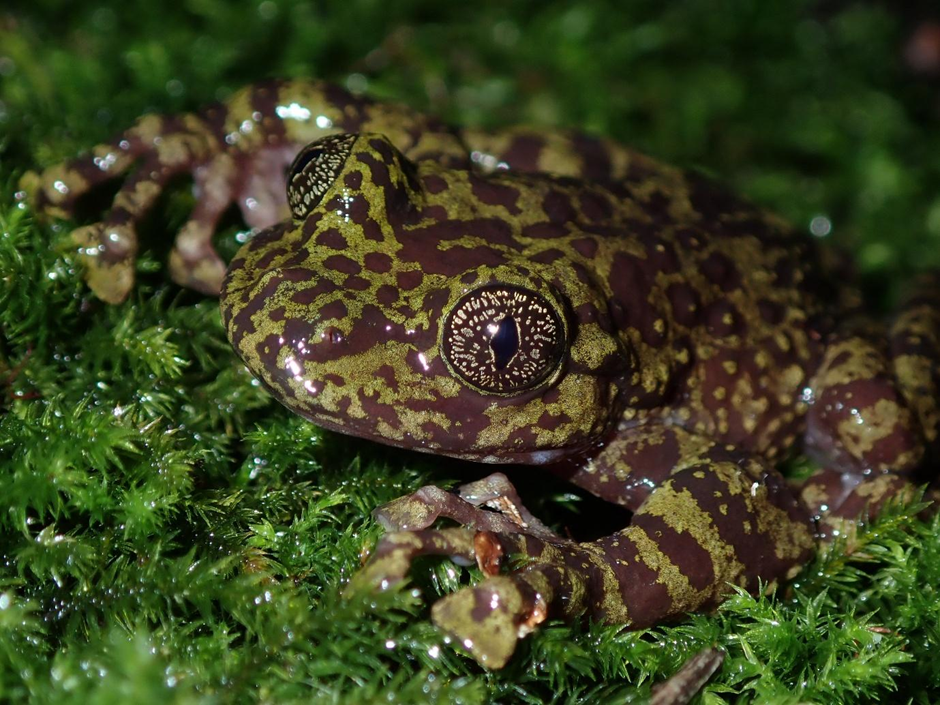
The Endangered Table Mountain Ghost Frog, Heleophryne rosei. Downlisted from Critically Endangered (2016) to Endangered (2025) during GAA3. A non-genuine change based on new information. Photo credit Joshua Weeber. For the assessment, see: Measey, G.J., Tolley, K.A., Turner, A.A. & Weeber, J. 2025. Heleophryne rosei. The IUCN Red List of Threatened Species 2025: e.T9773A247846769. https://dx.doi.org/10.2305/IUCN.UK.2025-2.RLTS.T9773A247846769.en.
Setting the foundation for GAA3
At a time when amphibian populations are declining faster than any other vertebrate group, global conservation decisions depend on the strength of regionally informed data. The upcoming Global Amphibian Assessment (GAA3) builds on the most comprehensive and collaborative effort to reassess the conservation status of amphibians globally. With amphibians recognised as the most threatened vertebrate group on the planet, the accuracy, consistency, and timeliness of regional assessments are critical. At Anura Africa, we are contributing directly to this global effort by leading and coordinating, together with the Endangered Wildlife Trust, Red List assessment updates for the Southern African region. Our mandate spans 247 amphibian species from 10 countries across Southern Africa, a region defined by exceptional endemism, strong biogeographic gradients, and rapidly intensifying land-use pressures. These assessments form the cornerstone of GAA3, ensuring that regional patterns of risk are fully represented in the global picture.
The assessment process
There is far more to producing a published Red List assessment than assigning an extinction risk category. Each assessment requires the synthesis of distribution data, population trends, habitat preferences, threats, and conservation actions, all evaluated against the IUCN Red List criteria and informed by specialists across the region. For Southern Africa, this process is particularly data-intensive, given the mix of well-studied species and incredibly rare or endemic species known from only a handful of historical records. Species distributions are reviewed and updated using the best available occurrence data, expert input, and recent field records. Threats are assessed within a Southern African context, accounting for land transformation, climate change, invasive species, pollution, and emerging disease risks. Following a workshop in April 2024, supported by the Amphibian Red List Authority (ARLA), a lengthy process of continued consultation with species experts produced the draft assessments for upload onto IUCN’s data management system, the Species Information System (SIS). Importantly, each assessment is then reviewed extensively by the ARLA to ensure consistency across taxa and countries, reducing bias and improving comparability.
Red Listing progress: 49 assessments published, 198 to go
A major milestone has already been reached: the first 49 Southern African amphibian assessment updates were successfully published on the IUCN Red List in October 2025. This included nine Endangered species, the remaining nine pending publication. There have been shifts in status for several species, with overall 30 species having a change in status since the previous assessments in 2016. The outcomes of the assessments were also incorporated into the South African National Biodiversity Assessment (NBA) 2025, directly informing national-level biodiversity indicators, conservation planning, and policy development. These respective outputs highlight the value of synchronising global and national assessment processes. By aligning Red List outputs with the NBA, the same body of work supports international reporting obligations while also strengthening evidence-based decision-making within Southern Africa. Key findings include, 22% of South African frog species are threatened, and of these 79% are under-protected. 61% of species are endemic to South Africa, with over half of these threatened. Leading causes of decline are invasive species, habitat loss due to agriculture, and modification of natural systems.
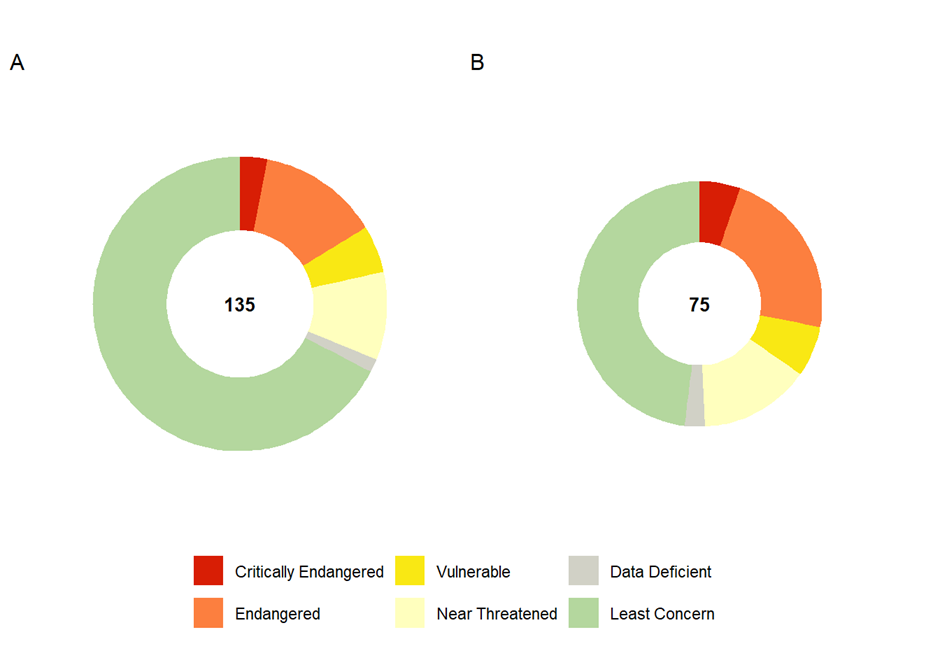
Threat status of South African amphibian species assessed following the IUCN 3.1 Red List Categories and Criteria. A shows the proportion of all species in each category, while B is the proportion of endemic species per category. The total number of species that have been assessed is indicated within each circle. Image courtesy of SANBI (South African National Biodiversity Institute)
While the publication of the first assessments marks significant progress, the scale of the task ahead may seem substantial. However, since the previous publication deadline, 188 additional assessments have been submitted to the IUCN and are awaiting publication. With fewer than ten assessments remaining in review, the finish line is now firmly in sight. What we have achieved thus far has required careful coordination, quality control, and collaboration with taxonomic experts, assessors, and reviewers across the region of Southern Africa. Maintaining momentum at this stage was paramount, particularly given global GAA3 timelines and the scale of cross-border coordination required. Standardised writing, shared data resources, and iterative internal reviews have been the currency for meeting tight deadlines while ensuring that each assessment meets IUCN standards.
Southern Africa’s contribution to the global picture
Southern Africa plays a disproportionate role in global amphibian conservation outcomes, given the region’s high levels of diversity and endemism. Robust assessments from this region are essential for accurately estimating global extinction risk and identifying priority areas for action. As GAA3 moves toward completion, the Southern African assessments will feed directly into global analyses of extinction risk, threat drivers, and conservation gaps. Beyond publication, these assessments provide a foundation for future research, monitoring, and on-the-ground conservation interventions. By delivering a complete and up-to-date set of assessments, Anura Africa is helping to ensure that Southern African amphibians are neither underrepresented nor oversimplified in GAA3.
We see this work as part of an ongoing commitment to amphibian conservation, and the systems, collaborations, and expertise developed through GAA3 will continue to support Red List updates, national assessments, and conservation planning well into the future.
No Comments Yet