
At the 2025 IUCN World Conservation Congress, held in Abu Dhabi this October, members approved Motion 075 guiding the global response to the amphibian extinction crisis. This resolution underscores the urgent need for governments and donors to step up with coordinated action and long-term investment to prevent further amphibian extinctions.
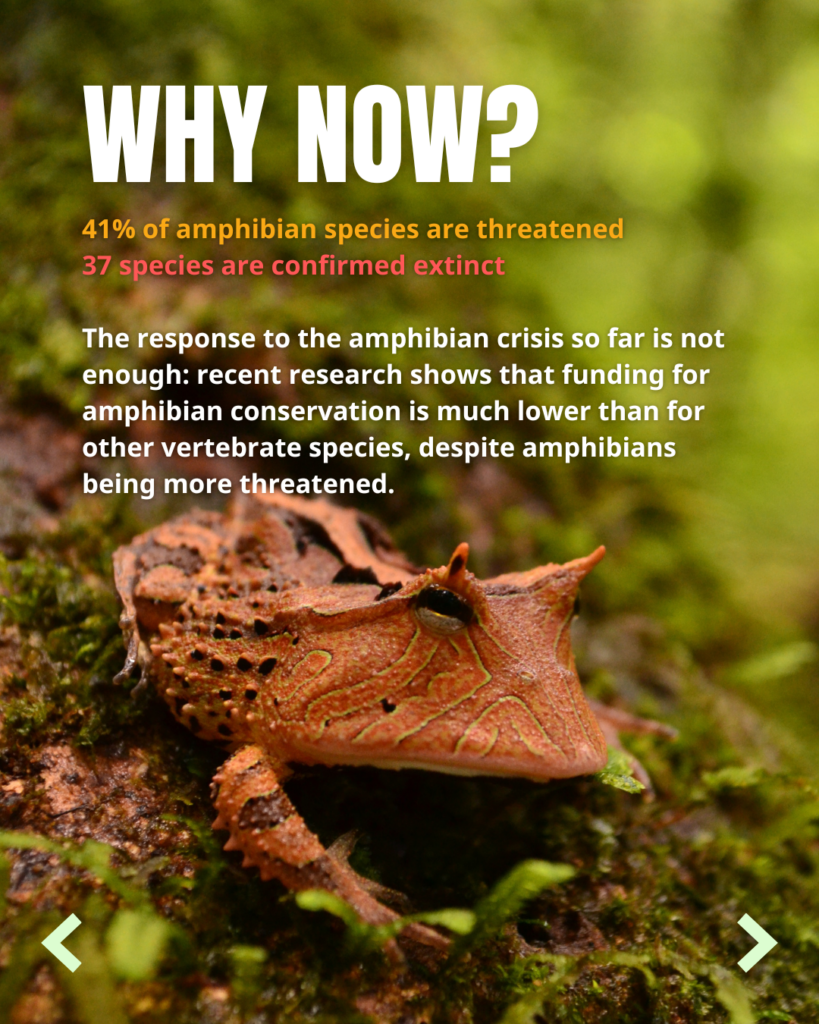
Despite decades of work, the second Global Amphibian Assessment (Luedtke et al. 2023) revealed sobering trends: 41% of amphibian species are threatened with extinction, 37 are confirmed extinct, and climate change has emerged as an additional driver alongside habitat loss, disease, and exploitation. This pattern varies among regions and species but paints a worrying picture overall (see the State of the World’s amphibians).
The new resolution, drafted by Re:wild and Synchronicity Earth, reviewed by members and experts in the IUCN SSC Amphibian Specialist Group (ASG), Conservation Planning Specialist Group (CPSG), Amphibian Ark (AArk) and Amphibian Survival Alliance (ASA), and submitted by Synchronicity Earth, aligns with the 2024 Amphibian Conservation Action Plan (ACAP), which provides a framework for regional and national action. This resolution calls for:
- – Governments to prevent amphibian extinctions by investing in long-term, country-level implementation of the IUCN Assess-Plan-Act framework; protect Key Biodiversity Areas and other habitats important for amphibians; and continue to promote the regulation and monitoring of species involved in trade.
- – Donors to provide sustainable support and funding to the SSC and its amphibian conservation partners.
- – The collaboration of the SCC and the scientific community with others to update and develop guidelines on key topics of relevance to amphibian conservation, including measures for amphibians impacted by climate change, management of disease in the wild, appropriately sized natural reserves, and other thematic issues as required.
We also call upon the Director General of the IUCN, the Species Survival Commission, non-governmental organizations, donors, and the scientific community to support governments in exercising their full responsibilities to achieve Targets 1, 3, and 4 of the Kunming-Montreal Global Biodiversity Framework, which include acting to prevent amphibian extinctions and support their recovery through long-term country-level investment in the Assess-Plan-Act framework of the IUCN.
ASG and the IUCN Resolution
“For the ASG this IUCN resolution reinforces what we know” said ASG Co-Chair, Sally Wren. “Conservation works for amphibians, but we need to significantly scale up efforts if we are going to reverse the current trend and achieve a world where amphibians thrive in nature. The resolution calls on governments to step up their efforts for amphibians, and for donors to provide sustainable support – both will be key to achieving success”
In line with this motion, ASG will continue to:
- – Provide guidance on key topics of relevance to amphibian conservation providing a robust evidence base for action
- – Support a network of experts implementing amphibian conservation research and action, and
- – Assess the status of amphibians through the IUCN Red List and Green Status of Species assessments, which are coordinated by the Amphibian Red List Authority (ARLA), to help us prioritise efforts and measure success
Prof. Amaël Borzée, ASG Co-Chair added “The change that this Resolution can spark could become paramount for amphibian survival, as preventing further amphibian extinctions is not only a conservation imperative but also essential for maintaining the health and stability of ecosystems worldwide upon which human well-being also depends“.
You can read more in our recent publication in Oryx magazine.

Find the approved IUCN Motion 075 here. This motion was submitted by Synchronicity Earth, and co-sponsored by the following organizations: Re:wild (USA), Zoological Society of London (UK), PROVITA (Venezuela), New Mexico BioPark Society (USA), Durrell Wildlife Conservation Trust (UK), Mandai Nature Fund Ltd (Singapore), Wildlife Trust of India (India), Herp Conservation Ghana (Ghana), FUNDAECO- Fundación para el Ecodesarrollo y la Conservación (Guatemala).
Background on IUCN motions:
Motions are the mechanism by which IUCN Members influence third parties and guide the policy and Programme of IUCN. As the only international conservation forum that brings governments, civil society and indigenous peoples’ organizations to the same table, the IUCN Members’ Assembly carries a powerful mandate. Members vote to approve motions, and once adopted, they become Resolutions and Recommendations, and therefore the body of IUCN’s general policy. (Taken from IUCNcongress2025.org).
No Comments Yet